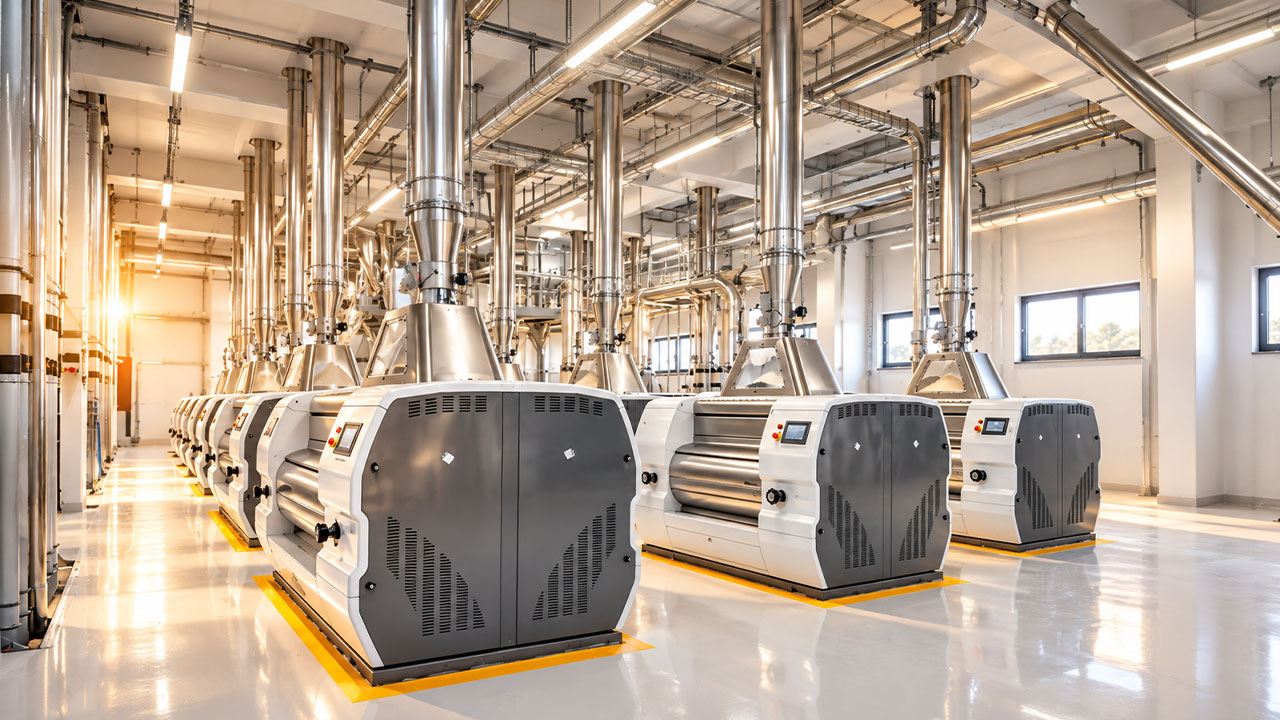

The 60 kWh/Ton Excellence: Anatomy of a High-Efficiency 130 t/24h Flour Mill on 4 Floors
In the contemporary milling sector, combining extraction yield maximization with energy consumption reduction represents one of the most complex engineering challenges. Traditionally, designing a long diagram for soft wheat has required tall buildings—often five or six floors—to use gravity and limit pneumatic lifting costs.
Today, an innovative 130 tons per 24 hours plant spread over only four floors breaks those industrial paradigms. The mill reaches top commercial quality while recording a global consumption index of just 60 kWh per ton processed, including first and second cleaning.
Below is a technical analysis of the pillars that make this reference benchmark possible—and how roller mill and plant engineering from Alapros support similar goals in milling projects.
The Milling Diagram: Length and Purity Without Compromise
The plant follows a high-precision long diagram philosophy across 14 total passes:
- 4 breaks: Progressively and geometrically open the grain while preserving bran integrity.
- 4 reductions: Calibrated reduction of pure semolina into fine flour.
- 6 finishers: A powerful tail section that millimetrically scrapes remaining endosperm from bran streams, maximizing extraction without penalizing quality.
With a total roll frontend of 17.5 linear metres, the plant offers a specific frontend of about 13.5 mm per quintal per 24 hours. Rolls work without excessive pressure or overheating—a “cold” milling process that preserves gluten and starch functionality.
Strategic purifiers clean semolina before reduction rolls, enabling extremely pure Type 00 flour with minimal ash.
The Roller Mill Revolution: Liquid-Cooled Direct-Drive Torque Motors
The energetic heart of this efficiency is the roller mill section (including feeders), where specific electrical absorption is only 21 kWh per ton. This is achieved with liquid-cooled torque motors direct-coupled to the roll shafts.
Beyond energy savings, eliminating belt drives delivers:
- Top safety: No belts, pulleys or countershafts—fewer entanglement risks during inspection.
- Hygiene: No rubber belt wear dust; liquid cooling replaces fan-driven air flows that spread flour dust.
- Minimal maintenance: No belt tensioning or gearbox lubrication cycles on the drive train.
- Acoustic comfort: Near-silent direct-drive operation in the roller mill room.
- Energy and thermal efficiency: Full transmission efficiency and controlled stator temperature, limiting heat in the milling room.
4-Floor Optimization and Stream Management
Achieving 60 kWh/t in a four-floor building is a layout achievement. Reduced building height limits gravity advantage; the plant compensates through integrated design:
- Cleaning integration: First and second cleaning condensed with combined machinery and unified high-efficiency air circuits.
- Smart pneumatics: High-pressure fans on inverters, synchronized via SCADA, modulating power to actual throughput of 5.41 t/h.
Energy Flow Balance (full capacity, 5.41 t/h)
| Plant section | Specific consumption (kWh/t) | Hourly power (kW) | Note |
|---|---|---|---|
| Roller mills & feeders | 21.0 | 113.6 | Liquid-cooled direct-drive torque motors |
| 1st & 2nd cleaning | 13.0 | 70.3 | High-density combined machinery |
| Plansifters & purifiers | 6.5 | 35.2 | Optimized sifting surfaces |
| Pneumatic transport & aux. | 19.5 | 105.5 | High-pressure fans with inverter control |
| Total electrical | 60.0 | 324.6 | Overall plant requirement |
| Locker room heat recovery | — | +4.5 kWt | Useful heat from liquid cooling circuit |
Thermal Circular Economy: Waste Heat Recovery
Total efficiency extends beyond the electrical panel. Heat from torque motor losses (about 4% of absorbed power) is captured by the cooling fluid and exchanged with locker-room heating. Over 24 hours of continuous operation, the system delivers more than 100 thermal kWh per day at no fuel cost—stable comfort during winter shift changes without dedicated heat pumps.
Conclusions
This 130 t/24h plant shows how innovation can overcome past structural constraints. By combining a 17.5-metre long diagram, direct-drive torque motors and integrated heat recovery, the facility sets a new benchmark for sustainability, hygiene and safety in modern milling—objectives that align with turnkey flour mill engineering from Alapros.
More on roller mills