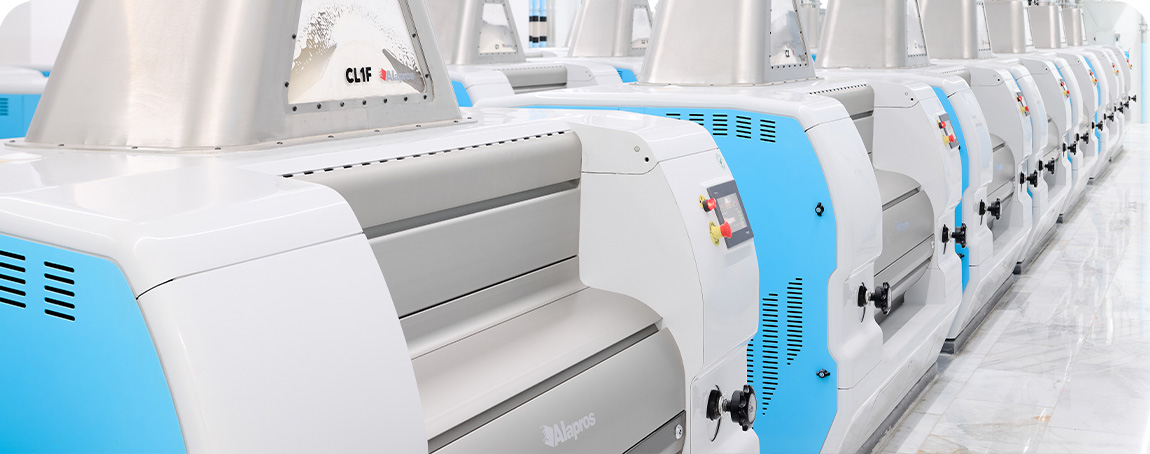

Roller Mill Maintenance: How Design Supports Long-Term Performance
In a modern milling plant, equipment needs to provide reliable performance over long operating periods. Proper roller mill maintenance is therefore an important consideration when selecting milling equipment.
Maintenance requirements are influenced not only by operating practices but also by machine construction, bearings, belt systems, lubrication and automation. The Alapros Roller Mill incorporates several features designed to support durability, efficient operation and low maintenance requirements.
Durable Machine Construction
A strong machine structure is essential for industrial milling applications.
The Alapros Roller Mill uses specially sourced steel for its machine body, with appropriate welding methods selected according to the application. Its main frame is designed as an integrated single body assembled through welding and screwing, helping increase resistance to excessive loads and vibrations.
This construction provides a stable foundation for the grinding and drive components.
Stainless Steel Product Contact Surfaces
Hygiene and durability are also important in cereal processing.
The product contact sections of the Alapros Roller Mill are manufactured using AISI 304 stainless steel. This material provides resistance to oxidation, corrosion and wear while supporting hygienic product contact.
For milling facilities, selecting equipment with appropriate materials can support both operational reliability and hygiene requirements.
Precise Roller and Belt Adjustment
Consistent roller mill performance depends on accurate mechanical adjustment.
The Alapros Roller Mill features a fine adjustment system operated by a moment arm mechanism for precise roller adjustment.
The machine also uses a Polly V belt tensioning system patented by Alapros R&D. The system allows manual belt tension adjustment with micron-grade precision.
These features make adjustment an important part of the machine's overall mechanical design.
Bearing Design and Service Life
Bearings are critical components in rotating machinery, making bearing construction an important consideration for milling equipment maintenance.
The Alapros Roller Mill uses cast bearing bodies made from GGG 45 to 50 material. Heat treatment and cold surface hardening are applied before metal processing. These processes are designed to support efficient operation and longer bearing service life.
Gas relief valves on the bearing covers release oil vapour caused by heat and help extend oil service life.
Sensors and Automatic Protection
Automation can also contribute to equipment protection.
The machine includes speed sensors for feed rolls and grinding rolls as standard. Feed motors operate synchronously by monitoring main motor current and speed, while feed speed is controlled according to the hopper level.
If product flow becomes insufficient, capacitive sensors can stop feeding and move the breaking and crushing cylinders into an idle position. This helps reduce unnecessary wear on grinding components and lowers energy consumption.
Supporting Efficient Operation
Roller mill efficiency is closely connected to how effectively the machine manages its mechanical and electrical systems.
The Alapros Roller Mill is designed for low energy consumption and optimal operating cost. Its automatic response to insufficient product flow prevents unnecessary operation, while its feeding and speed control systems help regulate the milling process.
An optional technology package is also available with vibration, temperature and stopper sensors, along with a centralized lubrication system.
A Practical Approach to Roller Mill Maintenance
A reliable roller mill should be evaluated not only by its grinding capacity but also by its construction, adjustment systems, bearing design and maintenance requirements.
The Alapros Roller Mill combines durable construction, precise adjustment, controlled feeding and optional monitoring technologies to support long-term industrial operation.
For flour mills and cereal processing facilities, these features make maintenance, efficiency and machine durability important factors when selecting a roller mill solution.
More on roller mills