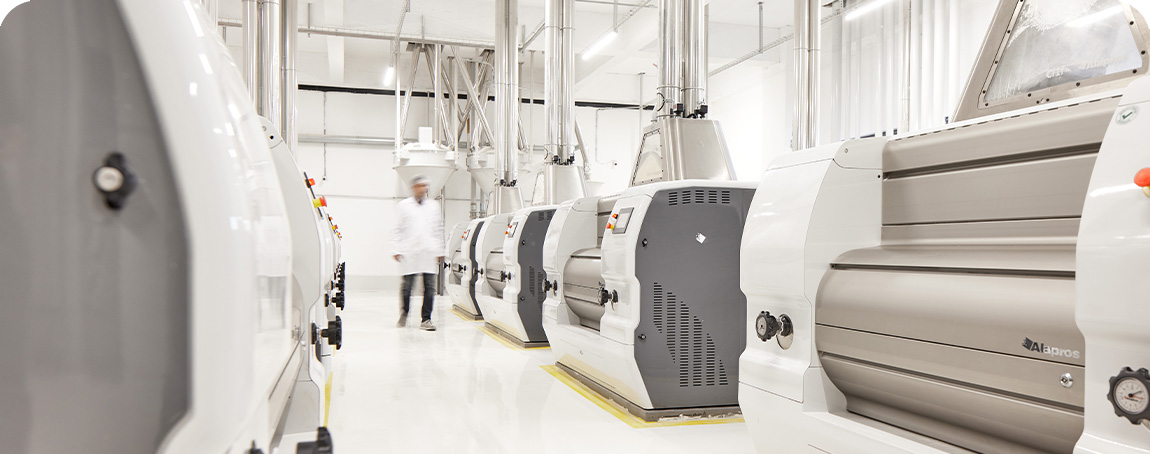

Roller Mill for Flour Milling: Improving Efficiency and Product Quality
Efficient grinding is one of the most important stages in modern flour milling. A well-designed roller mill for flour milling helps process cereals through controlled breaking and crushing, making it an essential part of flour and semolina production systems.
Roller mills can be used in different numbers within a milling system depending on the technical capacity of the plant and the type of product being processed. In addition to flour and semolina factories, they can be used for processing cereals such as rice, corn, rye and barley, as well as in coffee grinding plants.
How Does a Roller Mill Support the Milling Process?
The main purpose of a roller mill is to break and crush cereal products in a controlled manner. The Alapros Roller Mill includes a product entry box, feeding system, breaking and crushing cylinders, scraping brush and blade system, pneumatic components and electric automation systems.
The product enters the machine through the inlet box, while the feeding speed is controlled according to the required capacity. The roller cylinders can then be adjusted using a precise adjustment system. Once the desired product flow is achieved, the system can be locked into position.
This controlled process is important for maintaining consistent operation throughout the milling system.
Precise Roller Adjustment
Precision is an important factor when selecting flour milling equipment. The Alapros Roller Mill features a fine adjustment system operated by a moment arm mechanism, allowing more precise roller adjustments.
The system also monitors the feeding process through speed sensors for the feed rolls and grinding rolls. Feed motors operate synchronously according to the current and speed information of the main motor, while feed speed is controlled according to the roller hopper level.
These features help maintain controlled material flow and stable machine operation.
Reducing Unnecessary Wear and Energy Consumption
An efficient roller mill machine should be able to respond to changing production conditions. If the incoming product becomes insufficient during operation, capacitive sensors can stop the feeding system and move the breaking and crushing cylinders to an idle position.
This helps reduce unnecessary wear on the scraping brushes, crushing cylinders, cylinder surfaces and scraping blades. It also contributes to lower energy consumption because idle motors draw less electric current.
Durable Construction for Industrial Use
Durability is another important consideration for industrial milling equipment. The Alapros Roller Mill uses specially sourced steel for its machine body, with appropriate welding methods applied according to the application. Product contact sections are manufactured from AISI 304 stainless steel, providing resistance to oxidation, corrosion and wear while supporting hygienic operation.
The integrated main frame is assembled through welding and screwing and is designed to provide resistance against excessive loads and vibrations.
A Reliable Solution for Cereal Processing
A modern roller mill for flour milling needs to combine precise grinding, controlled feeding, durable construction and efficient operation.
The Alapros Roller Mill brings these features together in a system designed for flour, semolina and various cereal processing applications. With precise adjustment, automated feeding control and components designed for long-term operation, it provides an important solution for modern milling plants.
More on roller mills