
How Does a Roller Mill Work? Understanding the Grinding Process
If you are researching how a roller mill works, it is important to understand that modern roller milling involves more than simply passing grain between two cylinders.
A roller mill combines controlled product feeding, breaking and crushing cylinders, precise roller adjustment, sensors and automation systems. These components work together to process cereals according to the requirements of the milling plant.
Roller mills are used in flour and semolina factories as well as plants processing products such as rice, corn, rye and barley.
1: Product Feeding
The roller milling process starts when the product enters the machine through the inlet box.
The feeding system controls the product flow toward the grinding section. According to the required capacity, the machine controls its input speed. This allows the product to enter the grinding section in a controlled manner.
Controlled feeding is essential because the grinding cylinders need a consistent product flow for stable operation.
Step 2: Breaking and Crushing
After feeding, the product reaches the breaking and crushing cylinders. These cylinders perform the primary mechanical grinding operation.
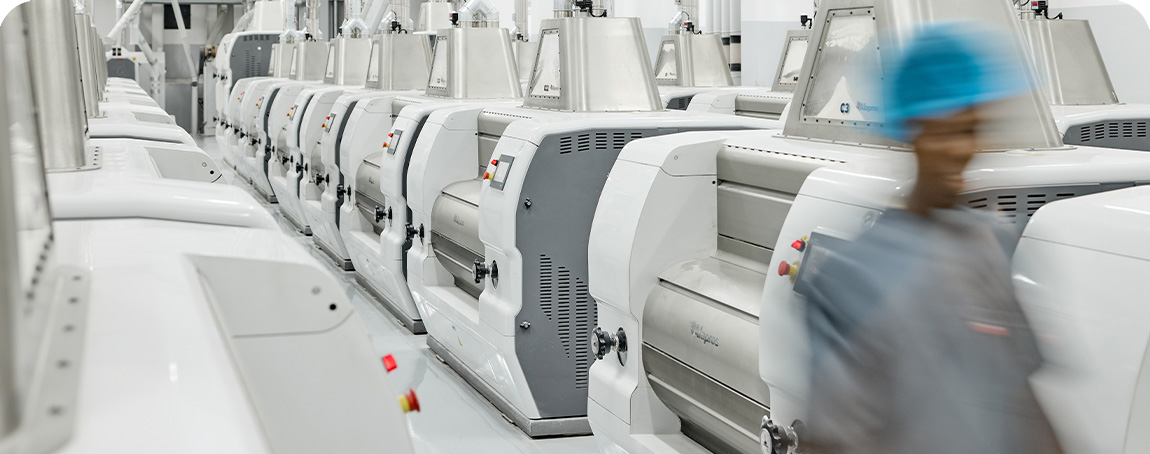
Roller mills can be integrated into a milling system in different numbers depending on the plant's technical capacity and product requirements. Their operation is determined according to the flow diagram of the complete milling system.
This allows the same basic roller milling technology to be adapted to different cereal processing applications.
Step 3: Roller Adjustment
Precise adjustment is an important part of the roller mill working principle.
The Alapros Roller Mill uses a precise adjustment system for its roller cylinders. Once the standard product flow is achieved, the rollers can be locked into position. The machine also features a fine adjustment mechanism operated by a moment arm for more precise roller adjustment.
This provides operators with greater control over the grinding conditions.
Step 4: Monitoring and Automation
Modern roller mill operation also depends on monitoring systems.
The Alapros Roller Mill includes speed sensors for feed rolls and grinding rolls as standard. Feed motors operate synchronously by monitoring the current and speed information of the main motor. Feed motor speed is also controlled according to the roller hopper level.
The machine's pneumatic system is supported by electric automation components and speed control systems. Clean air is supplied to the pneumatic system continuously at 6 bar after passing through dryers.
Automatic Response to Insufficient Product
One of the important functions of the system is its ability to respond when there is not enough product entering the machine.
Capacitive sensors can stop the feeding system and move the breaking and crushing cylinders into an idle position. This helps prevent unnecessary wear on the grinding components and reduces energy consumption because idle motors draw less electric current.
Why Is Roller Milling Important?
A roller mill provides controlled mechanical processing as part of a complete cereal milling system. Its effectiveness depends on the interaction between feeding, roller adjustment, grinding, monitoring and automation.
Understanding how a roller mill works is therefore useful when evaluating equipment for a flour mill or other cereal processing facility.
The Alapros Roller Mill combines these functions in a system designed for controlled cereal breaking and crushing, providing a practical solution for modern milling operations.
More on roller mills