
How to Build a Modern Wheat Flour Mill: From Planning to Commissioning
Constructing a modern wheat flour mill is far more complex than assembling milling equipment inside a building. Every successful flour production facility begins with detailed engineering, carefully planned process design, and the integration of technologies that work together as one complete production system.
As global demand for high-quality flour continues to increase, flour producers are investing in facilities capable of delivering greater efficiency, consistent product quality, lower energy consumption, and long-term operational reliability. Achieving these goals requires much more than selecting individual machines - it requires a complete turnkey approach.
At Alapros, we design and build turnkey wheat flour mills that combine engineering expertise, advanced manufacturing, automation, installation, and technical support into one integrated project. Every plant is tailored to the customer's production targets, raw material characteristics, and market requirements.
Every Flour Mill Starts with Understanding the Customer
No two flour mills are exactly alike. Differences in wheat varieties, desired flour specifications, production capacities, local regulations, and available infrastructure mean that each project requires a customized engineering approach.
The first stage of every project focuses on understanding the customer's objectives. Production capacity, product portfolio, extraction targets, site conditions, future expansion possibilities, and investment strategy are carefully evaluated before engineering begins.
This early planning phase significantly influences the efficiency of the entire production facility.
Designing the Entire Production Flow
Once the project requirements are established, process engineers begin developing the complete production flow.
Every section of the factory must work in harmony, beginning with grain reception and continuing through cleaning, conditioning, milling, sifting, purification, flour handling, storage, and packing.
An optimized process layout minimizes unnecessary product movement, reduces energy consumption, simplifies maintenance, and improves production stability. Rather than focusing on individual machines, engineers concentrate on the complete processing system.
The Importance of Grain Cleaning
The quality of flour begins before the wheat reaches the roller mills. Effective cleaning protects downstream equipment while improving flour quality.
Modern cleaning systems typically include technologies such as Electronic Sorting, Vertical Debranners, Vibratory Grain Separators, Classifier Destoners, Intensive Scourers, Scourers, Trieurs, Hammer Mills, and Box Magnets.
Each machine removes different impurities and prepares the grain for efficient milling. Proper cleaning contributes directly to longer equipment life, improved extraction rates, and higher food safety standards.
Precision Milling Technology
The milling section represents the core of every flour factory. Here, grain is gradually reduced into flour while preserving quality characteristics and maximizing extraction efficiency.
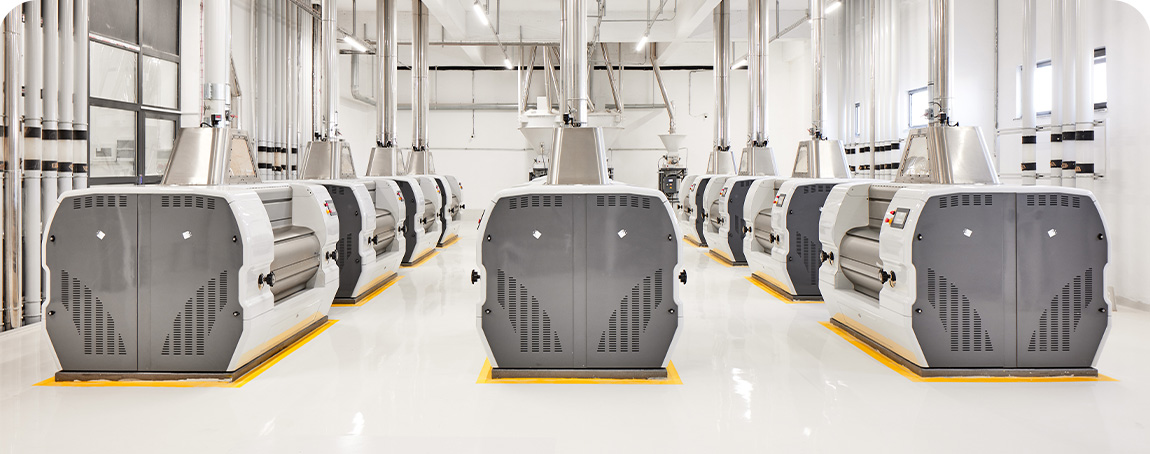
Roller Mills perform controlled grinding, while Square Plansifters separate products according to particle size. Control Plansifters maintain process consistency, Semolina Purifiers improve product purity, Impact Detachers increase flour release, and Bran Finishers recover valuable flour from bran.
When these technologies are engineered as one integrated process, the entire milling operation becomes more efficient and easier to control.
Automation Makes the Difference
Modern flour mills depend heavily on automation. Automation systems continuously monitor machine performance, product flow, energy consumption, and production parameters.
Operators receive real-time information that allows rapid adjustments while maintaining consistent product quality. Automation also improves traceability, minimizes operator errors, reduces downtime, and supports preventive maintenance strategies.
For large industrial flour mills, automation has become an essential component of operational excellence.
Digital Plant Simulation Before Construction
One of the most valuable engineering tools available today is 3D plant simulation. Before manufacturing begins, engineers digitally model the complete factory.
This virtual environment enables investors to review building layouts, machine locations, maintenance access, material flow, utility routing, and overall production efficiency.
Potential design improvements can be implemented before construction begins, reducing installation time and avoiding costly modifications during commissioning.
Installation Requires Engineering Expertise
Even the highest-quality machinery cannot deliver optimal performance without professional installation.
Mechanical erection, pneumatic systems, electrical infrastructure, automation integration, testing, calibration, and commissioning must all follow carefully planned engineering procedures.
Working with one turnkey supplier ensures every department collaborates throughout the installation process. This coordinated approach significantly reduces project risks while accelerating startup.
Long-Term Performance Matters Most
The completion of construction is only the beginning of the relationship. Reliable flour production depends on operator training, technical support, spare parts availability, and continuous process optimization.
As production demands evolve, milling facilities often require performance improvements or capacity expansions. Working with an experienced engineering partner ensures these developments can be implemented efficiently while maintaining production stability.
Why Turnkey Projects Deliver Better Results
Choosing separate contractors for engineering, machinery, automation, installation, and commissioning often creates communication challenges that delay projects and increase costs.
Turnkey delivery eliminates these risks by placing one experienced company in charge of the complete investment. The result is a more efficient project, faster commissioning, and better long-term operational performance.
Conclusion
Building a successful wheat flour mill requires much more than purchasing advanced machinery. It demands integrated engineering, optimized process design, professional installation, intelligent automation, and continuous technical support.
With turnkey project management, every stage of the investment is carefully coordinated to achieve maximum efficiency and long-term reliability. For flour producers seeking sustainable growth and competitive production capabilities, partnering with an experienced turnkey flour mill manufacturer provides a strong foundation for lasting success.